
by ANDREA McHUGH • photography by ERIN McGINN
Hours before the champagne corks pop and pretty ladies sporting flowing flowery dresses and designer bags prance about the pavilion’s tables draped in crisp white linens, the polo grounds at Portsmouth’s Glen Farm hum with a palpable energy. The rattling sound of ice jostling into coolers at the bars reverberates, the booming PA system is tested with voices and music, and the massive Jumbotron videowall flashes images while workers zip furiously about, readying for the thousands that will soon descend on this historic swath of land in the middle stretch of Aquidneck Island.
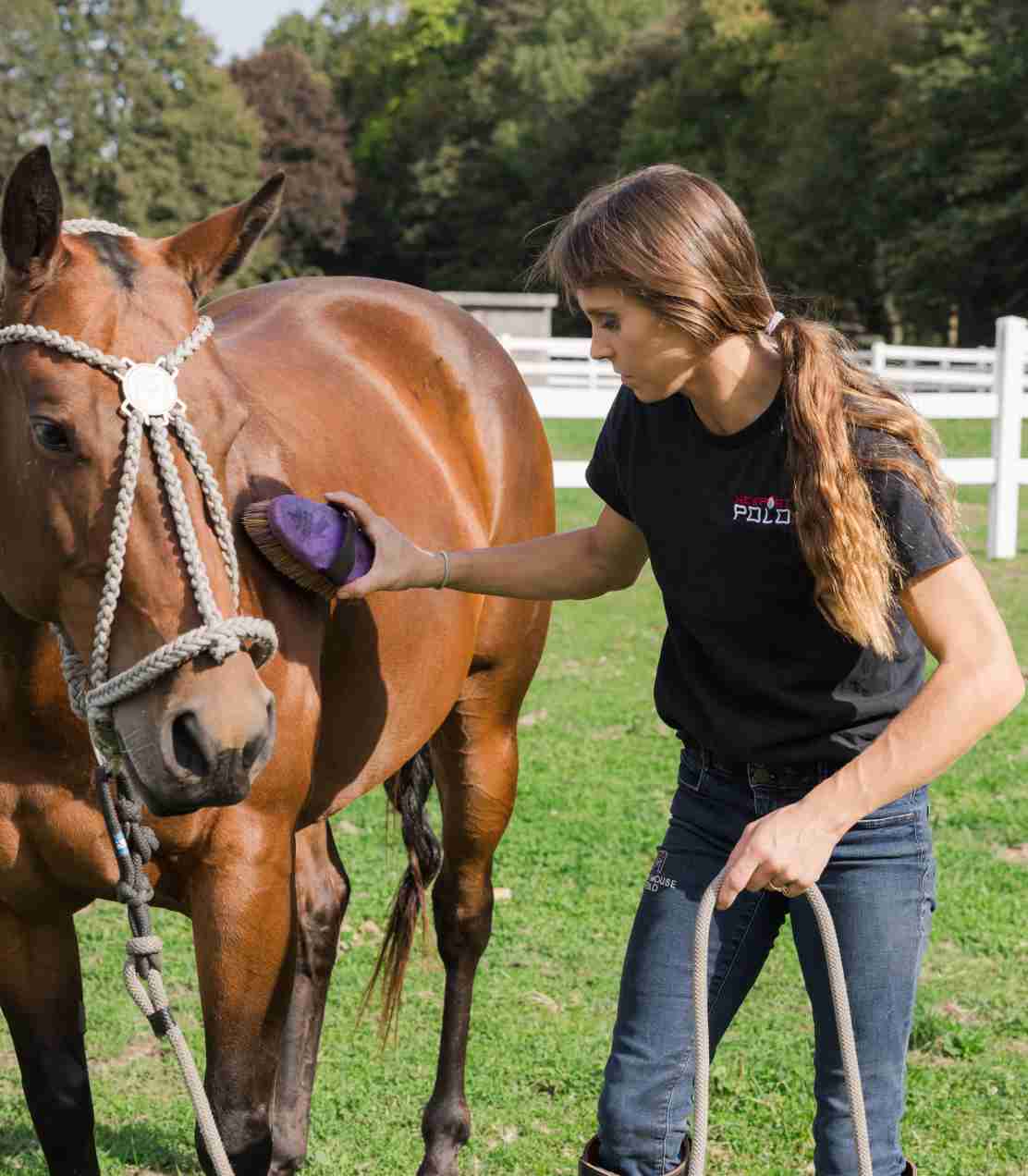
Along the easternmost side of the property, Minnie Keating tends to the ponies elegantly grazing in the grassy paddocks. She calls each one by name, and will ensure that by gametime, they will be properly outfitted for the day’s match; their legs wrapped tightly for support and protection, saddles cinched tight, and tack secure.
Her petite stature masks the ruthless competitor she becomes once the match begins, seemingly fearless as she charges for the ball, weaving gracefully between opponents, wielding a mallet in her right hand while commanding a 1200-pound horse going 25 miles per hour with her left. With hearts pumping, players grunting, and sweat dripping, the genteel game of polo becomes a clash of power and speed without warning. Speed, agility, and endurance are the hidden currency of victory; what every match is built on, and it’s what Minnie has in spades, because she’s barely known a life without it.
“Even before I could walk, my dad would take me — I couldn’t even hold my own neck up — and he would take me on horseback around the nurseries, and I’d fall asleep,” she says with a soft laugh. Her father, Dan, started playing polo in his 20s. Much like many to pick up the mallet, it didn’t take long for him to be hooked. (Tommy Hitchcock, considered one of the greatest American polo players of all time, famously said, “Once a man has had a taste of it, the task of curing him is rather hopeless.”)
![]()
I’ve pretty much been fully submerged in horses and some element of the farm since I was itty bitty. There was a brief hiatus when I decided I didn’t like horses and I wanted to be, quote unquote, normal.
Minnie Keating, Newport Polo ![]()

Above: The early years – riding with her dad Newport Polo founder Dan Keating. Tending ponies in the paddocks behind the polo field.
In 1990, 26-year old Dan signed a ten-year lease with the Town of Portsmouth to rehabilitate Glen Farm and make it a premier polo destination — no small feat, considering the farm’s years of neglect. Driven by more than just passion, his mission was to restore polo’s international tradition in its American birthplace.
The sport of polo arrived on Newport’s shores during the Gilded Age in the 1800s, millennia after its earliest known roots in Central Asia. The first polo club in the U.S. was the Westchester Polo Club, which formed in 1876 and quickly made Newport its summer headquarters and polo grounds. Ten years later, the inaugural tournament of the International Polo Cup took place at the Westchester Polo Club in Newport, solidifying its reputation as the premiere summertime destination for international polo, joining other aristocratic sporting competitions here including sailing, tennis and golf. Newport maintained its esteem as the international polo capital of the world for nearly 40 years, until the swift one-two-three punch of income tax, WWI, and The Great Depression dismantled the fortunes of many families dedicated to the sport.
The original club remained active until 1929, remaining on seemingly permanent hiatus until 1992, when Dan and his wife Agnes revived what’s known popularly as Newport Polo, though the club remains registered with the United States Polo Association under the historic Westchester name.
Along the easternmost side of the polo grounds, Minnie Keating tends to the ponies elegantly grazing in the grassy paddocks. She calls each one by name, and will ensure that by gametime, they will be properly outfitted for the day’s match.
Minnie spent the earliest years of her childhood at Glen Farm, moving just a few miles north when she was nine years old. “I’ve pretty much been fully submerged in horses and some element of the farm since I was itty bitty,” she says. Except for that short, pre-teen chapter where she realized her life looked a bit different than her schoolmates’. “There was a brief hiatus when I decided I didn’t like horses and I wanted to be, quote unquote, normal,” she chuckles. “I thought it was just something dads do together, like fishing, so I was like, ‘That’s so boring.’ But when I saw big girls playing polo, I was like, ‘Oh my gosh, if they can do it, I can do it too.’” The “big girls” were cool teenagers, and she was all in.
Minnie got serious, competing on Newport’s Interscholastic Polo Team through high school. She didn’t compete while in college in Colorado, but stayed closely connected to the equine community there, riding, umpiring, and doing “chalk talks” the term for coaching or teaching sessions. By the time she graduated, the Keating’s Newport International Polo Series was attracting thousands of spectators eager to watch heart-pounding matches unfold at Glen Farm in the warmer months. Tailgaters set up elaborate picnic spreads, while a pavilion offered an elevated experience. Though known as “The Sport of Kings,” the Keatings ensured the polo experience was accessible, with adult tickets around the same price to see a movie at the theater, and free admission for kids.
Minnie was, and still is, easy to spot on game day, typically marked by her favorite color, pink, manifesting on her helmet or on her pony in one way or another. Off the field, she devoted herself to horse care and studying how other polo programs thrived. “From every resource I could find, whether that be in France or in Florida and all different places, I studied how to run a polo operation. I got my coaching certificate and really heavily invested myself in equine care, medicine and welfare to be more of use to our program.”
Today, at 31, she’s the Director of Equine Management for Newport Polo, as well as head instructor and manager of Newport’s Polo School. She also coaches Brown University Polo as well as Newport’s Girls, Open, and middle school teams.
But the snapshot thousands of Newport Polo fans glimpse of her on late Saturday afternoons from late spring through early fall, high atop a staggeringly large horse (in polo, they’re called “ponies,” no matter their age or size), whizzing at warp speed with grace and precision through each of the six chukkas, is just a sliver of polo life.
It’s a Wednesday evening in late August, and a faint coolness lingers, whispering that autumn is on the doorstep. Making use of every drop of fading sunlight, Minnie carefully tends to an inflamed hoof. She’s clad in an old Brown sweatshirt, comfortable pants and weathered boots, hair haphazardly tied back and a smile across her face.
“Polo has this facade, or not facade, but it has a presentation of being very well to do, and in reality, if you’re a polo player, you’re sweaty, you’re covered in dirt, you’re shoveling horse poo, you’re cleaning your tack and checking on your horses late at night. Personally, I see tons of ‘farm’ people who, sure, also clean up and go to the fancy dinners down in Newport, but in their regular day to day life, they’re all out here,” she muses.
Along with her family, Minnie is also committed to growing the sport, which means working with kids who take an interest, offering lessons to young and old, and creating entry points so that it can be a sport of the many and not the few. “We offer things like work to ride to allow people from all backgrounds the opportunity to be involved in the sport. Even our club membership is more affordable than pretty much anywhere else in the country to try to promote people to be involved in the sport,” she says. “We try to have a variety of people from different countries and people from different age groups. Inclusivity is massively important to Newport Polo. It’s not just for the wealthy.”
But the legacy of the sport, particularly here and what it carries, what it represents, is not lost on her, especially when she travels internationally to play. “We’re representing the Newport Polo name and the Westchester Polo Club name, in a different way than maybe some people from other states and other clubs,” she says. “We’re representing the oldest club In America, which is tied to all of the great history of Newport itself and the famous families from the old days that would come up from Westchester, New York, and spend their summers here doing polo and sailing.”
![]()
Polo has this facade, or not facade, but it has a presentation of being very well to do, and in reality, if you’re a polo player, you’re sweaty, you’re covered in dirt, you’re shoveling horse poo, you’re cleaning your tack and checking on your horses late at night.
Minnie Keating, Newport Polo ![]()
Above: Transporting ponies in a very large trailer? “No problem,” says Minnie. “No one else dares to drive it!” Minnie’s nod to all things pink (and another famous Minnie) – her Mad Mouse Polo branding is in full force.
Deep Blue Details
Newport Polo
Host of the International Polo Series
Celebrating 150 Years
(Matches begin June 6, 2026)
250 Linden Lane
Portsmouth, RI
401.846.0200
NewportPolo.com
Polo photos: John Lincourt, Jim Curren, courtesy of Newport Polo.