by ANDREA McHUGH • photography by ERIN McGINN
In a city brimming with old houses, the Wanton-Lyman-Hazard house makes “old” feel laughably inadequate, and it’s Newport native Dr. Akeia de Barros Gomes who is going to take the nearly 330-year-old home into the future.
Built decades before the American Revolution, the house predates the nation itself by nearly a century. Perched at the corner of Broadway and Stone Street, it has quietly borne witness to major milestones and mundane city life. It housed a future governor of the colony of Rhode Island, endured the city’s British occupation, and survived an angry mob that attacked when the English loyalist living there penned a pamphlet supporting Parliament’s right to tax the colonies.
The house also sheltered enslaved people. That chapter of its story is explored through the broader lens of Newport’s Black history at the Edward W. Kane and Martha J. Wallace Center for Black History. The Newport Historical Society celebrated the center’s opening on Juneteenth, with de Barros Gomes at the helm.
“What people will see is a story of Newport’s history from the earliest documentation up until today,” she says. Rather than focusing on a single narrative, de Barros Gomes says the museum paints a layered portrait of Newport’s history.
“You can’t talk about Black history in Newport without talking about slavery, but it’s not the ‘Museum of Newport Slavery,’” she insists. “A lot of people think that it’s really important that we tell the story of Newport’s role in the transatlantic slave trade and how central we were in it, but my fear and focusing on that is that we’re not telling the stories of people of African descent, we’re telling the stories of the system of oppression of people of African descent. The way that I navigated that and decided to do storytelling in that space, is that space is really about Newport’s place in the African diaspora.”
![]()
You can’t talk about Black history in Newport without talking about slavery, but it’s not the ‘Museum of Newport Slavery.' The way that I navigated that and decided to do storytelling in that space, is that space is really about Newport’s place in the African diaspora.
Akeia de Barros Gomes, Newport Historical Society ![]()
De Barros Gomes grew up in Newport and studied anthropology and archeology at Salve Regina University in Newport. She went on to earn her PhD from the University of Connecticut with a dissertation focusing on the free African American cultural landscape in Newport. Her work led to prominent curatorial positions at the New Bedford Whaling Museum and Mystic Seaport Museum, two institutions where maritime history and cultural storytelling intertwine, much like in Newport. Alongside her role at the center, she continues to serve as an adjunct lecturer at the Ruth J. Simmons Center for the Study of Slavery and Justice at Brown University.
De Barros Gomes was a board member at the Newport Historical Society when she offered to help executive director Rebecca Bertrand craft the new center’s job description. Then it hit her: this was exactly what she wanted to do.
“When we were in school and history books talked about Black people, it was southern slavery or the Civil Rights movement. It somehow never seemed to touch here, or have anything to do with us here, so it leaves you like, ‘Well, how did I get here?’” she explains. “Because I’m from the community, it feels like something I need to do so that we know we belong here. The kids need to know we belong.”
“Belonging” has evolved into the defining mission of her work and a north star for the center.
“If you are a middle schooler or high schooler that is a person of African descent, you don’t see very much that tells you you belong here; that Newport is yours just as much as it is that other person’s, and so I think fostering a sense of belonging, saying you have a history here, matters,” she says.
Throughout the centuries, Africans and people of African descent, enslaved and free, became part of Newport’s skilled labored force, created community and benevolent societies, established churches, and became business owners.
“And maybe your ancestors weren’t wealthy, but they were here, and they contributed to making the city what it is. Maybe the name of the first person who came to Newport and your family is forgotten, but they were here, their name was once known, and they did things to contribute to the city,” de Barros Gomes explains. “It’s this tapestry of stories and immigration and trauma and joy and beauty and all of that — and everyone has their layers that contribute to their tapestry — but Black history hasn’t been given the full opportunity to be part of the tapestry of that storytelling about Newport.”
Until now.
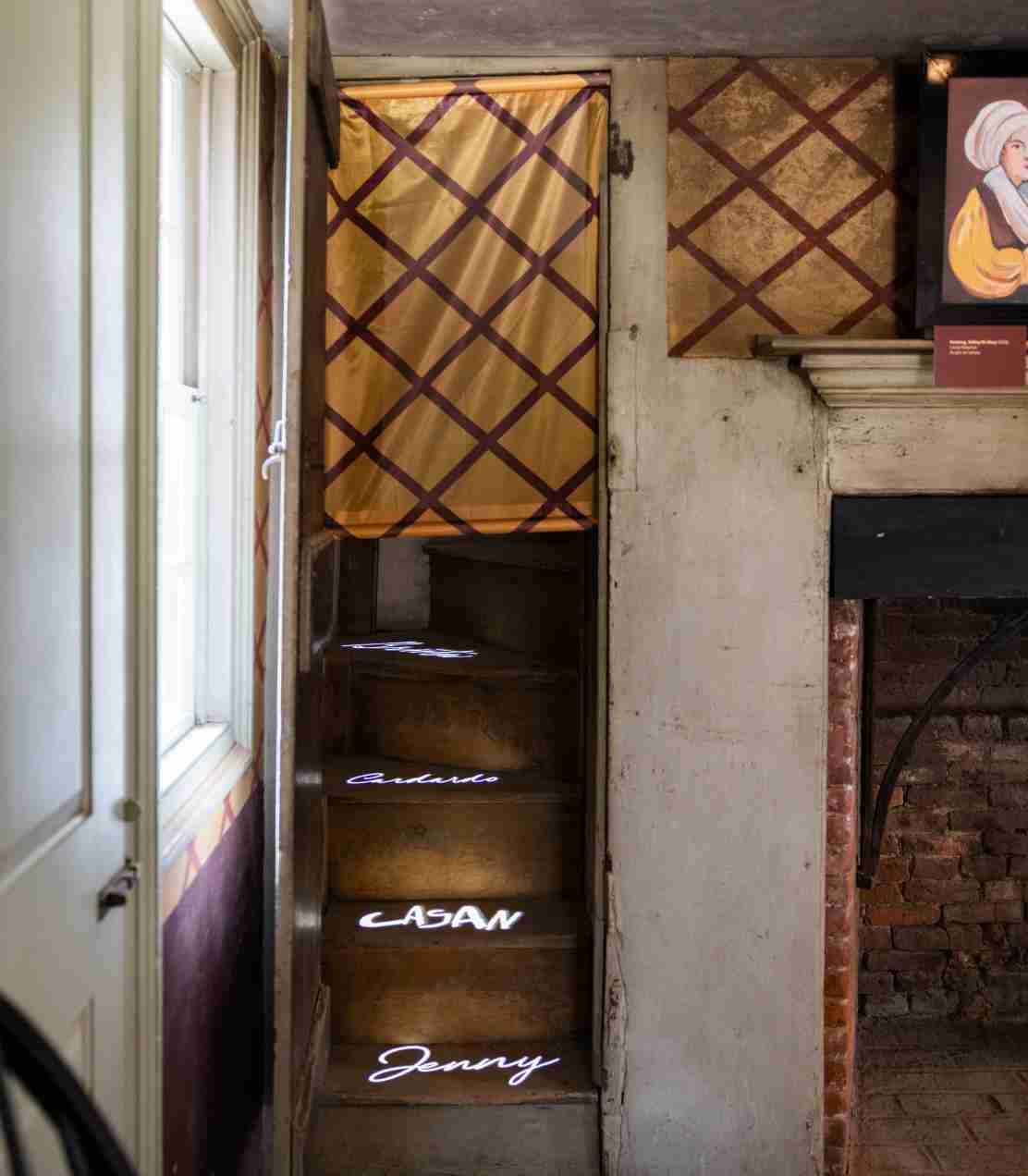
Among the artifacts are items from an 18th century nkisi bundle found under the floorboards of the attic discovered during an archaeological investigation in 2005. A nkisi is a collection of items that hold spiritual significance to its owner, this one likely the nkisi of an African man named Cardardo enslaved by John G. Wanton.
As the Wanton-Lyman-Hazard house has been a National Historic Landmark for nearly 100 years, the Newport Historical Society was careful to not make any architectural changes to the home. Visitors won’t see a fresh coat of paint on the walls or newly mounted pieces where they don’t belong. Visitors will enter through the kitchen, as that is where enslaved people in the home would enter, and be able to explore rotating and permanent interactive exhibits, historic photographs, and artifacts.
Among the artifacts are items from an 18th century nkisi bundle found under the floorboards of the attic discovered during an archaeological investigation in 2005. A nkisi is a collection of items that hold spiritual significance to its owner, this one likely the nkisi of an African man named Cardardo enslaved by John G. Wanton, a wealthy Quaker merchant who lived at the home.
“The bundle clearly demonstrates that even though enslaved people here would have been Christianized, they were holding on to African spirituality,” says de Barros Gomes. “It’s also really significant because it’s the only one that’s ever been identified in New England.”
The center also builds upon the ongoing work undertaken for Voices from the NHS Archives, a project centering Black and Indigenous experiences for a digital archive embedded in Newport’s historical record. More than 4,000 church records, business papers, ship logs and other archival materials from the society’s records were sourced for the project and it includes input from dozens of experts and advisors.
“People who come into the Center for Black History should be able to hear those stories and relate to their own family histories, or use our Voices database to really understand how their families got here — the backstories and all the interesting things they never heard that happened in their families,” says de Barros Gomes. “That, to me, is probably what’s most important about telling these stories.”
Bertrand believes de Barros Gomes is uniquely suited to lead the Center for Black History, calling it a “stars aligning” moment that is both meaningful and personal. “Akeia is an incredible curator; an incredible human being who is kind and compassionate, but also, she’s an archeologist, so she’s a person who understands objects,” she says. Bertrand also points to de Barros Gomes’ work as an anthropologist, noting that it has given her a deep understanding of the dynamics that shape communities and the broader society around them. “Most importantly, she’s a Newporter and grew up in this community, and I think she’s excited about seeing the way that people will interact with our community’s story, our community’s history, and our community’s future, because I think that more than anything, this house is about the future, it’s not just about the past.”
The years-the-making Center for Black History has come to fruition alongside ongoing community partnerships, including Newport Middle Passage Port Marker Project, the Dr. Martin Luther King, Jr. Community Center, Salve Regina University and Brown University. “Because we wanted to make sure that we’re working with the community always on this endeavor,” explains de Barros Gomes.
While confronting history often means reckoning with painful truths, she said, it also reveals stories of resilience, survival, perseverance and possibility.
“Ultimately, the hope is that people don’t leave with that heaviness,” she says. Though on a parcel flanked by two of Newport’s busiest streets, the property has a beautiful greenspace with a bench carved by third generation stone carver, letterer, and Newporter, Nick Benson. His workshop, The John Stevens Shop, is located on Thames Street and was founded in 1705 — just a few short years after the Wanton-Lyman-Hazard house — and has been operating as a stone carving shop continuously since that time. The bench Benson has carved for the center honors Newport’s enslaved stone carvers and Black craftsmen. Says de Barros Gomes, “Visitors can go out into the yard and they can reflect or see that it’s really a story of regeneration and rebirth and creativity and joy and family and kin and community and all those things that the Black community has always been.”
![]()
Built decades before the American Revolution, the house predates the nation itself by nearly a century. It housed a future governor of the colony of Rhode Island, and endured the city’s British occupation. The house also sheltered enslaved people.
![]()
DEEP BLUE DETAILS
Edward W. Kane and Martha J. Wallace
CENTER FOR BLACK HISTORY
Newport Historical Society
17 Broadway
Newport, RI
Open: Tuesday-Sunday, 10am-5pm